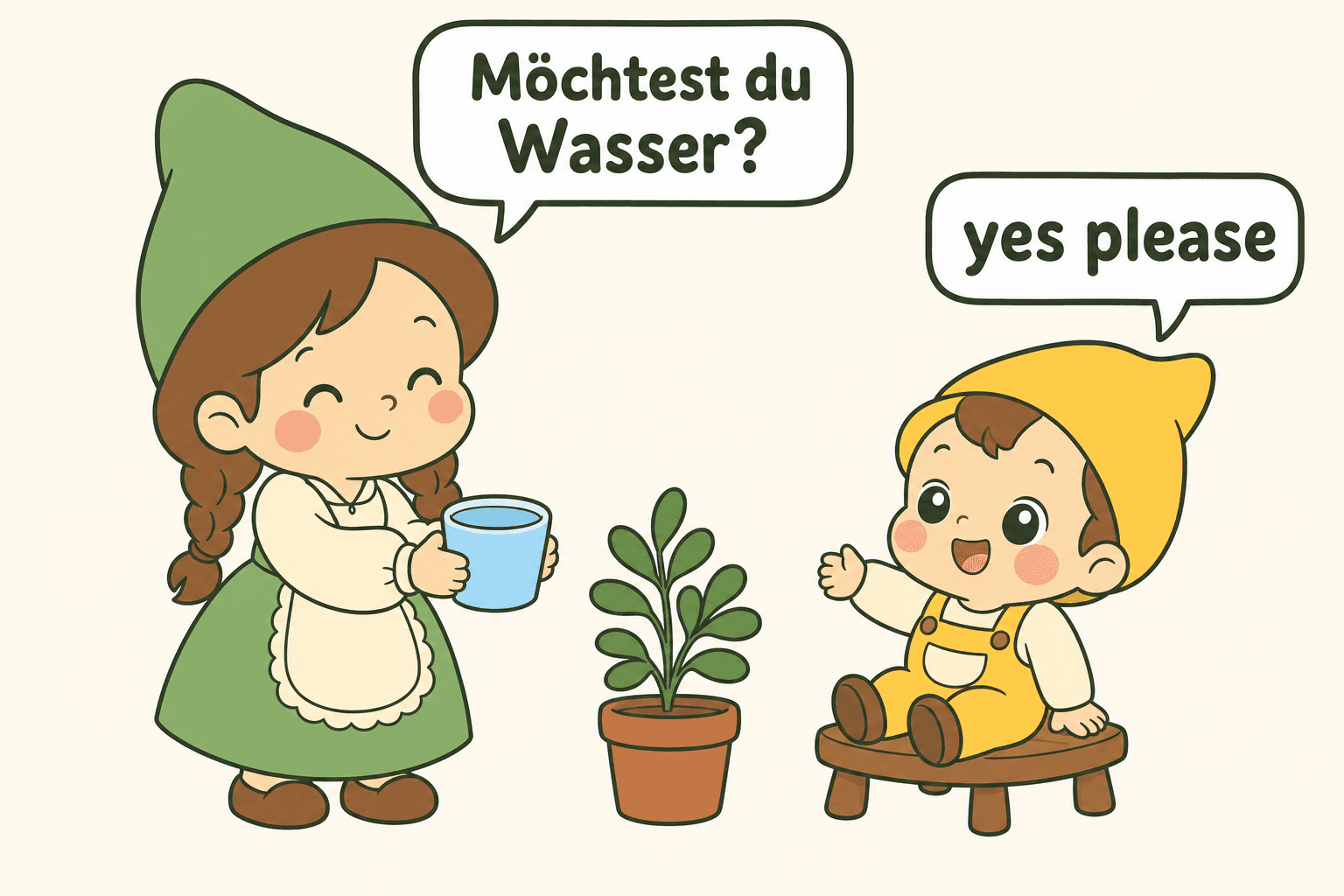
Your child answers in English. Every time.
It rarely happens on a particular day. At some point you ask „Möchtest du noch Wasser?“ and get back “yes please.” Then again. And again. Your child understands everything — and has stopped answering in German.
The first thing worth knowing: this is not a parenting failure. It’s so common that it has its own name.
It’s called receptive bilingualism
Researchers call it receptive or passive bilingualism: comprehension is there, active production isn’t. Understanding and speaking are two separate skills. Understanding comes first and stays stable far longer.
That’s the good news. If your child understands you, the foundation exists. Building on it is much easier than starting from zero.
Why children switch
Children are linguistically ruthless about efficiency. They pick whichever language gets them what they want fastest. Three forces push in the same direction:
- Volume. Once daycare starts, the ratio flips. Forty hours a week of the community language against a couple of German hours in the evening isn’t a fair contest.
- Status. Children work out early which language “counts” on the playground. The language of friends wins.
- Path of least resistance. If English always works — because you understand it perfectly well — there’s no reason to switch.
What actually helps
The families who turn this around are rarely the stricter ones. They’re the ones who changed a few habits.
1. Don’t answer the English question
Not as punishment — as reflex. Warmly repeat in German what your child just said, then answer that. “Can I have milk?” → „Du möchtest Milch? Hier ist deine Milch.“ No comment, no correction. You simply hand back the German version.
2. Ask questions that can’t be answered with yes
„War es schön?“ invites one word. „Was habt ihr heute im Garten gemacht?“ requires a sentence. For little ones, forced-choice questions are the trick: „Möchtest du den roten oder den blauen Becher?“ — both answers are German.
3. Fixed anchors beat good intentions
“We’ll speak more German” doesn’t survive a week. “Breakfast and bath time are in German” survives, because it’s attached to something that happens anyway. Two reliable moments beat resolving to hold out all day.
4. Don’t correct language mixing
„Ich will noch mehr juice“ is not a regression. Mixing is normal in bilingual children and a sign that both systems are live. Take the sentence up in German and carry on.
5. Bring the other parent in
In many families German switches off precisely when everyone is together — because one person can’t follow. A handful of fixed German phrases for the non-German-speaking parent changes more than any extra reading session. More on that in OPOL vs. minority language at home.
How long does it take?
Honestly: there’s no reliable number, and anyone who gives you one is guessing. What families report again and again is an order — single German words come back first, then short sentences, then whole situations. And that it takes weeks, not days.
That’s the real problem: during the weeks when something is shifting, you can’t hear it yet. Most parents stop too early because they can’t see any progress.
Which is exactly what we’re building Wortbeet around: small rituals that attach to the day you already have — and progress you can see before you can hear it.